
Agentic coding: what it actually is and why developers keep talking about it
If you've spent any time on developer Twitter or Hacker News in the past year, you've probably seen the term "agentic coding" thrown around constantly. It's one of those phrases that gets used so much it starts to feel meaningless. But there's something real happening here, and if you're just starting to explore AI coding tools, understanding the distinction between regular AI assistance and agentic AI is genuinely useful.
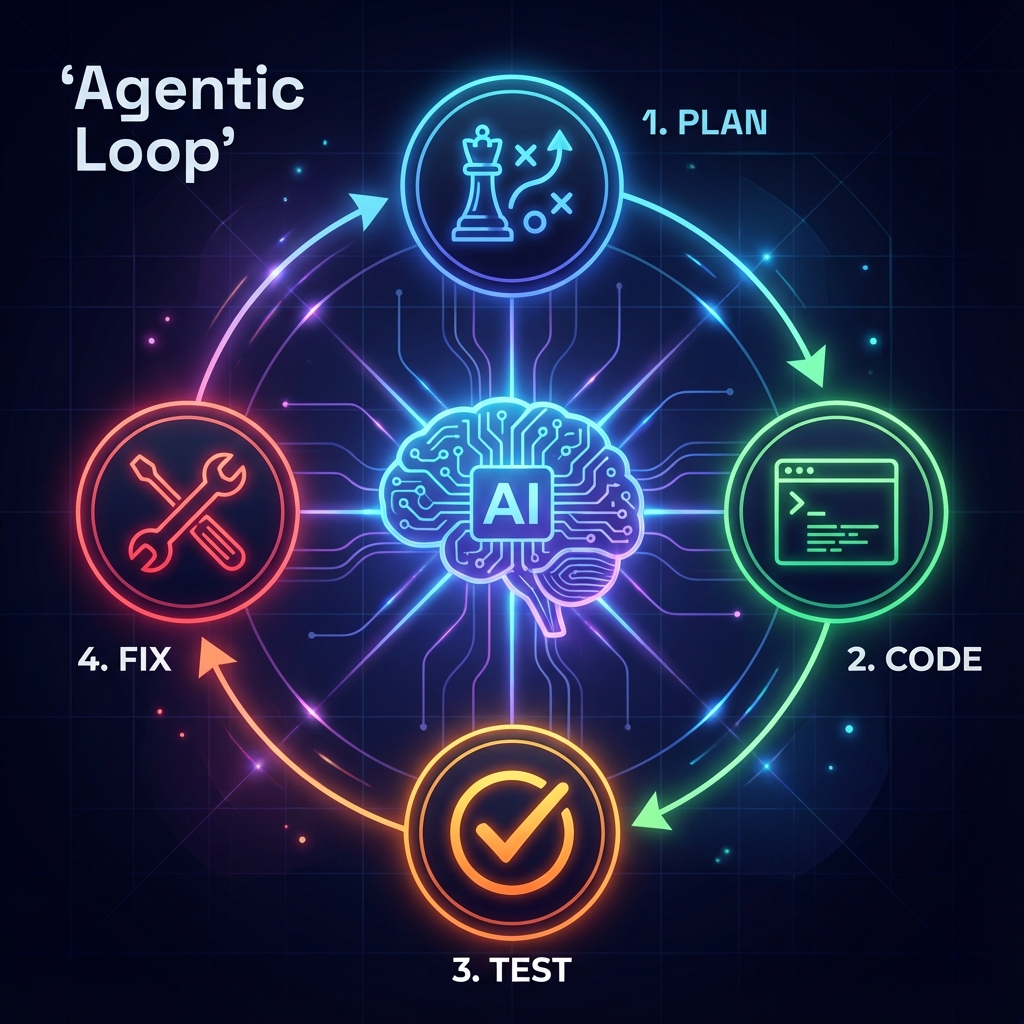
Here's the short version: agentic coding is when AI tools stop waiting for you to drive every decision and start doing actual work on their own. Instead of suggesting your next line of code, an agentic system takes a goal like "add authentication to this API," breaks it into steps, executes those steps, runs the tests, fixes what breaks, and keeps going until the task is done - or until it gets stuck and asks for help.
The difference matters because it changes what you can realistically accomplish with AI assistance. Let's dig into where this came from and what tools are actually worth your attention.
From autocomplete to autonomous: how we got here
The story of agentic coding is really a story about several technologies maturing at once and then combining in interesting ways.
GitHub Copilot launched in June 2021 as the first mainstream AI pair programmer. Built on OpenAI's Codex model, it was impressive for its time - you'd type a function signature or a comment, and it would suggest the implementation. But it was fundamentally reactive. Copilot waited for you to type, analyzed what it could see, and offered suggestions. You were still in the driver's seat for every single decision.
The tools couldn't be agentic yet because the underlying models had severe limitations. GPT-3 had a 2,048 token context window - roughly 1,500 words. That's not even enough to hold a moderately complex file in memory, let alone understand how different parts of a codebase fit together. The AI could see a keyhole view of your code.
Three breakthroughs changed this:
First, context windows expanded dramatically. Claude 2 shipped with 100,000 tokens in 2023. GPT-4 Turbo pushed to 128K. By 2024, Claude 3 offered 200K tokens, and Gemini 1.5 Pro hit a million. Suddenly the AI could actually read and reason about entire codebases, not just the file you happened to have open.
Second, function calling arrived in June 2023. This is the technical capability that actually makes agents possible. Before function calling, language models could only output text. With it, models can output structured instructions that tell surrounding systems to do things - read this file, run this command, call this API. The model doesn't execute the action directly; it generates a specification that your environment executes. This lets AI move from talking about code to actually manipulating it.
Third, researchers figured out that prompting models to think step-by-step (chain-of-thought reasoning) dramatically improved their performance on complex tasks. The January 2022 paper from Google researchers showed this clearly. Combined with better models, this meant AI could actually plan multi-step approaches to problems instead of just pattern-matching on immediate context.
Devin's announcement in March 2024 marked the moment "agentic" entered mainstream developer vocabulary. Cognition Labs marketed it as "the world's first AI software engineer" that could work autonomously for hours. The claims were met with healthy skepticism - independent testing showed mixed results - but it crystallized the concept of AI that operates more like a junior developer than an autocomplete engine.
What actually makes something agentic
The industry uses "agentic" loosely, so here's what the term meaningfully refers to. An agentic coding tool exhibits these characteristics:
Autonomy. It doesn't wait for you to guide each step. You give it a goal, and it figures out how to accomplish it. Some tools have worked autonomously for seven or eight hours on complex tasks while engineers provided only occasional guidance.
Tool use. The model can read files, write files, execute terminal commands, run tests, and sometimes interact with browsers or external services. This is function calling in action - the model outputs structured instructions, the system executes them, and results flow back for the model to interpret.
Planning and iteration. When an agentic tool hits an error, it doesn't just stop. It reads the error message, hypothesizes about causes, tries fixes, and loops until things work - or until it recognizes it's stuck. This is fundamentally different from autocomplete, which has no concept of whether its suggestions actually function.
Context awareness across your project. Agentic tools index your codebase and understand relationships between files. They trace imports, read configuration, and check test files to understand patterns. They're not limited to what's visible in your editor.
Here's a concrete example of the difference. Say you need to add JWT authentication to all API endpoints in an Express app.
With traditional autocomplete, you open a route file, start typing, accept suggestions for middleware imports, move to the next file, type more, accept more suggestions. You manually run tests, manually fix failures, manually move between files. The AI helps with individual lines but you orchestrate everything.
With an agentic approach, you describe what you want: "Add JWT authentication to all /api/* endpoints." The agent analyzes your existing routes, identifies what needs protection, checks for existing auth middleware, creates or updates the middleware, modifies the route handlers, updates the tests, runs the test suite, fixes failures, and presents you with a summary of what changed. You review the diff and approve it.
That's a real workflow difference, not marketing spin.
The tools worth knowing about right now
The agentic coding space moves fast, but a few tools have established themselves as the serious options for developers exploring this space.
Cursor is probably the most mature agentic IDE. It's a VS Code fork with AI capabilities built in at every level - autocomplete, chat, and a full Agent mode that can edit multiple files, run commands, and iterate on errors autonomously. Cursor supports multiple models (Claude, GPT-4, Gemini) and has attracted serious adoption from companies like Stripe. The Pro tier costs $20/month, though they recently switched to usage-based pricing that's caused some grumbling in the community. There's a functional free tier for trying it out.
Claude Code is Anthropic's entry, and it takes a different approach - it lives in your terminal rather than replacing your editor. You run claude from the command line, describe what you want, and it reads your codebase, makes changes, runs tests, and handles git workflows. If you're comfortable in the terminal and practice test-driven development, the workflow feels natural. It's included with Claude Pro ($20/month) though there are usage limits.
GitHub Copilot has evolved significantly from its 2021 autocomplete origins. The current Agent Mode (available in VS Code) can iterate autonomously, fix errors, and suggest terminal commands. It has the deepest GitHub integration - it understands issues, PRs, and Actions. The free tier gives you 2,000 completions and 50 agentic requests monthly. Pro is $10/month, making it the cheapest mainstream option.
Devin went from $500/month to $20/month in April 2025, making it accessible for individual developers. It operates with the highest autonomy level - you can assign it tasks and walk away. The trade-off is reliability: benchmark scores don't always translate to real-world results, and it works best for well-defined, routine tasks rather than novel or complex problems. Think of it as a capable but literal-minded junior developer.
Amazon Q Developer deserves mention if you work in AWS environments. It scored highest on SWE-Bench (the standard benchmark for these tools) and has a unique strength: a transformation agent that can upgrade legacy code (Java 8 to 17, .NET Framework to .NET 8) largely autonomously. The free tier is generous.
For the privacy-conscious or those wanting full control, Cline is an open-source VS Code extension that provides agentic capabilities with whatever model you choose to connect - cloud APIs, local models via Ollama, whatever. You bring your own API keys and pay only for what you use. It's completely transparent and actively maintained by a growing community.
Some practical guidance for getting started
If you're new to AI coding tools, starting with GitHub Copilot's free tier makes sense. The Agent Mode gives you a feel for agentic workflows without switching editors or setting up new accounts. Once you understand what these tools can and can't do, you'll have better intuition for whether Cursor's deeper integration or Claude Code's terminal workflow fits how you actually work.
Don't expect magic. These tools are most effective for tasks that are well-defined and have clear success criteria - adding features with obvious test cases, refactoring code with established patterns, migrating between framework versions. They struggle with ambiguous requirements, novel architectures, and anything requiring deep domain expertise you haven't documented somewhere the agent can read.
The developers getting the most value from agentic tools treat them like capable but inexperienced colleagues: clear instructions, well-scoped tasks, and always reviewing the output before it ships. The AI can write a lot of code quickly; verifying it does what you actually need remains your job.
That's the reality of agentic coding in late 2025: genuinely useful, occasionally impressive, not yet reliable enough to trust blindly. The tools are getting better fast, the prices are dropping, and the workflows are worth learning. Just don't believe anyone who tells you the technology has peaked - or that it's going to replace you next quarter.